The phrase “greenhouse effect” often appears in discussions of climate change and global warming. It is the name for a natural atmospheric process that largely determines Earth’s temperature and climate, making it livable. Without the greenhouse effect, Earth’s average surface temperature would be approximately 0°F rather than 59°F (NASA, 2025); thus, the greenhouse effect is essential to supporting liquid water over most of the planet and allowing life to flourish.
However, human activities are increasing the concentrations of the gases in the atmosphere that determine the strength of the greenhouse effect. The rising concentrations of these gases, called greenhouse gases, strengthen the greenhouse effect and cause more heat to remain on Earth.
To really understand how human activities are altering this process, it is important to understand the science behind the effect. What is a greenhouse gas? How do greenhouse gases warm the planet? And how does the greenhouse effect work?
In 1901, Swedish meteorologist Nils Gustaf Ekholm first compared Earth’s atmosphere to a greenhouse to explain how it warms the planet’s surface. Although not perfect, the analogy helps us understand the basic idea behind the greenhouse effect. In a greenhouse, sunlight enters through the glass, warms the inside, and then the glass enclosure slows the loss of heat to the outside atmosphere.
Applying this analogy to Earth, it may seem like the greenhouse effect is primarily caused by the greenhouse gases in the atmosphere trapping heat beneath them like the glass roof of a greenhouse or a blanket on a cold day. This is not entirely wrong; however, it describes the result of the greenhouse effect rather than the process behind it. Because heat is a form of energy, understanding the greenhouse effect begins with how energy gets to Earth and changes from one form to another (NOAA).
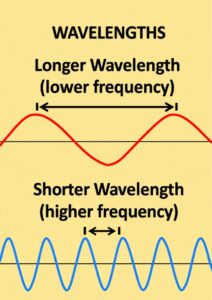
Let’s return to Ekholm’s explanation and look more closely at the energy flows that are occurring. Radiation is energy that travels from one place to another as electromagnetic waves. All objects above the temperature of absolute zero give off radiation because all atoms in matter are constantly vibrating (NASA). Very hot objects like the Sun emit energetic radiation called shortwave, or visible, radiation. Cooler objects, like Earth, emit less energetic radiation called longwave (or thermal) radiation (see figure 1).
The Sun emits radiation in a range of wavelengths that take about 8 minutes to travel through space to reach the Earth. In our greenhouse analogy, the glass roof allows the shortwave radiation to enter with very little absorption, at least on a clear day (see further reading). When a surface like a plant absorbs radiation, the energy is transferred to the atoms and molecules within the material. Their motion increases, raising the surface’s temperature. For example, in a greenhouse, the atoms in a tomato plant’s leaf and a puddle of water will begin to move faster—the same thing happens outside the greenhouse.
As these surfaces are warmed, they begin to emit long-wave radiation. The surrounding glass absorbs this outgoing infrared radiation and heats up, and then emits its own long-wave radiation in all directions. As a result, the glass gives infrared radiation to the warm ground, the air inside the greenhouse, and the surroundings outside. This means the greenhouse interior warms not only from incoming solar radiation, but also because the glass absorbs infrared radiation from the surfaces inside it and sends it back downward inside the greenhouse. The greenhouse also reduces the ways heat absorbed outside the greenhouse is lost by the surface. As the air inside becomes warm and humid, evaporation is greatly reduced, so plants and soil use less energy to evaporate water, leaving more heat to warm the greenhouse. Because the glass enclosure reduces the loss of energy and water vapor from the greenhouse, more of the Sun’s energy remains within the greenhouse, causing the air and surfaces inside to warm until the energy leaving the greenhouse once again equals the energy entering it. This adjustment process goes on until what scientists call an energy balance is achieved.
|
Figure 1. The electromagnetic spectrum represents the complete range of radiation. The region of the spectrum with a shorter wavelength than the color violet is referred to as ultraviolet radiation, and the region of the spectrum with a longer wavelength than the color red is referred to as infrared radiation (Florida Atlantic University). |
On Earth, greenhouse gases create a similar effect, reducing heat loss until warming increases the temperature enough to create an energy balance. Bright surfaces like clouds, snow, ice, and desert sand reflect a high fraction of the shortwave radiation striking them, while dark surfaces like forests, roads, and the oceans absorb 90% or more of the incoming solar radiation that strikes them. For the Earth system, roughly 30% of incoming solar radiation is reflected back out to space, leaving ∼50% to be absorbed by the Earth’s surface and ∼20% by the atmosphere (see figure 2).
Just like in the greenhouse, the Earth’s surface absorbs this radiation and emits longwave radiation back up to the atmosphere. The atmospheric greenhouse gases absorb most of the infrared radiation emitted by the surface before it reaches space. The atmospheric greenhouse gases then reradiate the energy they have absorbed as longwave radiation both upward and downward, sending a portion upward toward space, where higher-level greenhouse gases can absorb and reradiate it, and a portion back to the Earth’s surface. This absorption of the long-wave infrared radiation and downward re-radiation by the atmosphere warms the Earth’s surface, which in turn warms the lower atmosphere. Interestingly, the downward-directed longwave energy from the atmosphere provides a bit over twice as much energy as the incoming solar energy at the surface.
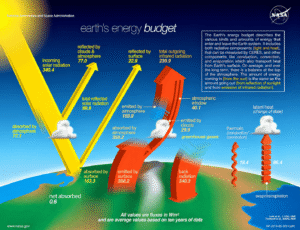
Figure 2. This diagram illustrates Earth’s energy budget, how energy flows into, through, and out of the Earth system. Satellite instruments measure the reflected solar and outgoing infrared radiation, shown here in watts per square meter (W/m²) (NASA).
So, atmospheric greenhouse gases act like a thermal blanket for Earth: they let most unreflected solar energy pass through to the surface, but when the surface re-emits it as longwave radiation, the gases absorb most of it and reradiate most of it back toward the surface. This reduces energy loss to space and warms the surface and lowest layer of the atmosphere (troposphere). Because warmer matter emits more radiation, warming the surface and troposphere increases the amount of energy emitted until the energy escaping to space once again balances the energy coming in from the Sun.
The main difference between the greenhouse analogy and how Earth functions is that, instead of glass, Earth has an atmosphere that includes greenhouse gases. Most of the atmosphere is made up of nitrogen and oxygen, which do not have the types of chemical bonds that will absorb and radiate heat. But the atmosphere also contains water (H₂O), carbon dioxide (CO₂), and other gases composed of three or more atoms. The chemical bonds holding these gases allow them to absorb and emit heat radiation, and they are aptly referred to as greenhouse gases. While largely “opaque” to longwave radiation, these gases are also largely “transparent” to shortwave radiation. When exposed to outgoing longwave radiation from the Earth’s surface, these molecules vibrate and bend, absorbing the energy and re-radiating it in all directions (MIT). In short, our Earth’s warmth is dependent on the atomic structure of molecules in the atmosphere that have three or more atoms.
Increasing carbon dioxide concentrations do not warm the Earth solely because more carbon dioxide absorbs more infrared radiation. Extra carbon dioxide changes where long-wave radiation escapes from the atmosphere. With more carbon dioxide molecules available to absorb long-wave radiation, radiation emitted from lower in the atmosphere is more likely to be absorbed before it can reach space. As a result, the radiation that does escape to space comes, on average, from higher in the atmosphere. Because the atmosphere generally gets colder with height, this higher layer emits less energy to space. Earth therefore temporarily loses less energy than it receives from the Sun, causing the surface and atmosphere to warm. As the atmosphere warms, the higher layers eventually become warm enough to emit enough energy to space to restore Earth’s energy balance.
Since the Industrial Revolution, human activities have substantially increased the amount of greenhouse gases in the atmosphere, particularly CO₂ and methane. As the concentrations of greenhouse gases rise, more of the longwave infrared radiation emitted by Earth’s surface is absorbed and re-emitted within the atmosphere. It is helpful to remember that the greenhouse effect involves not only radiation emitted by the Earth’s surface, but also absorption of infrared radiation emitted by other greenhouse gases, creating a complex exchange of energy throughout layers of the atmosphere that further reduces the rate at which longwave energy is emitted to space.
In determining the ultimate warming from an increase in the CO₂ concentration, it is also essential to consider the further warming influence created by water vapor, because the warmer the atmosphere, the more water vapor there will be in the atmosphere—and because H₂O has three atoms, it is also a greenhouse gas. An increase in carbon dioxide causes an initial amount of warming. Warmer air can contain more water vapor, and because water vapor is itself a greenhouse gas, this strengthens the greenhouse effect and causes additional warming. This is known as the water-vapor feedback, and it roughly doubles the warming that carbon dioxide would produce on its own. Warming also causes some snow and ice to melt. Because snow and ice reflect much of the Sun’s incoming energy, their loss makes Earth’s surface darker and allows it to absorb more solar energy. This causes additional warming, known as the ice-albedo feedback.
While doing the calculations of the greenhouse effect are complicated, the science all comes down to how the Earth’s greenhouse gases receive, absorb, transfer, and release energy—and what their concentrations are. The molecular structures of the greenhouse gases allow them to absorb long wavelengths of radiation that oxygen and nitrogen molecules cannot. When human activities add more greenhouse gases to the atmosphere (for example by burning coal, oil, and natural gas), this greenhouse effect that keeps the Earth from freezing becomes even stronger, retaining more energy within the Earth system and making the planet warmer. Thus, when thinking about the greenhouse effect and its effect on the Earth’s climate, it is important to zoom out and consider how energy interacts with the Earth’s greenhouse gases and how the resulting energy balance has made our planet habitable.
If you are interested in reading more about the science behind greenhouse gases and the greenhouse effect, explore further reading and resources:
What are Electromagnetic Waves?
NASA’s Comprehensive Guide to Climate and Earth’s Energy Budget
The Earth’s Energy Balance
The Chemistry Behind Greenhouse Gases
How are Greenhouse Gases Measured and Analyzed?
Scientists find cloud feedbacks amplify warming more than previously though