
The Climate Institute has developed a groundbreaking platform to identify, advance, and deploy emerging energy technologies in developing countries. By enabling a leap beyond legacy fossil fuel infrastructure, this work supports sustainable economic growth, resilience, and long-term prosperity.
The Emerging Technologies Initiative (ETI) focuses on decarbonizing developing economies through renewable energy generation, advanced storage, energy efficiency, and next-generation technology applications. By integrating innovation with practical deployment strategies, ETI helps countries transition directly to cleaner, more efficient energy systems.
Through longstanding global partnerships, the Climate Institute identifies and supports early-stage projects with high potential to transform energy systems. The program provides technology developers with access to research support, intellectual property guidance, policy frameworks, and pathways to real-world implementation in emerging markets.
Emerging technologies are innovations grounded in strong scientific research that are expected to scale rapidly and deliver significant economic and social impact. Over the next five to ten years, these solutions have the potential to reshape energy systems and accelerate climate progress worldwide.
For more information, please contact: Nasir Khattak – nkhattak@climate.org

Nasir Khattak is an entrepreneur and energy policy expert with more than 30 years of experience in sustainable energy, spanning international development and the private sector. As a member of the Board of the Climate Institute, he founded and led the Global Sustainable Energy Islands Initiative for two decades, working with UN agencies, regional organizations, and private partners to develop and implement sustainable energy strategies across small island states in the Caribbean, Africa, and the Pacific.
He is a recognized advocate for renewable energy and climate action, having spoken at major international forums, including the United Nations General Assembly.
In the private sector, Nasir has founded several companies—including TechNano, EMachines, and Microtron—focused on renewable energy systems, advanced battery technologies, and electric mobility solutions. His work has consistently supported the transition from fossil fuel–based systems to clean energy and electrified transport.
He holds a master’s degree in Environmental and Energy Management from George Washington University, as well as bachelor’s degrees in civil engineering and in law and political science from Peshawar, Pakistan.

Dr. Slobodan Petrovic serves as Director of Emerging Technologies at the Climate Institute and is a Professor of Electrical and Renewable Energy Engineering at Oregon Tech in Portland, Oregon. He brings more than 35 years of experience in science, engineering, and technology leadership.
A distinguished researcher and innovator, Dr. Petrovic has authored over 100 publications, holds more than 50 patents, and has written six textbooks covering batteries, electrochemistry, renewable energy, and photovoltaic systems. His research spans MEMS device fabrication, sensors, fuel cells, applied electrochemistry, and advanced energy storage technologies.
Prior to his academic career, Dr. Petrovic held senior industry roles, including Chief Technology Officer and Vice President of Engineering in leading fuel cell and battery companies, and served as a professor of Alternative Energy Engineering at Arizona State University.
He is also the Founder and President of Solar Hope, a nonprofit organization dedicated to expanding access to renewable energy in developing countries. His work—particularly across Africa—has positively impacted more than one million people.

Dr. Xin Zhao is Director of Special Projects at the Climate Institute and a materials scientist specializing in carbon nanomaterials and advanced energy systems.
His research focuses on bioelectronics, biosensors, supercapacitors, electrochemical analysis for life and health sciences, fuel cells, and next-generation battery technologies for hybrid energy systems. He is particularly known for his work on graphene-based materials and their applications in energy storage.
Dr. Zhao earned his Ph.D. in Materials Science from the College of William and Mary in 2006, where his research centered on vertically oriented graphene nanosheets. He also holds a master’s degree in Materials Science from Tsinghua University in Beijing.
From 2007 to 2013, he served as a postdoctoral fellow and later as a staff scientist at the Thomas Jefferson National Accelerator Facility (U.S. Department of Energy). In recognition of his pioneering work on graphene-based supercapacitors, he received the World Technology Award in Energy in 2011.

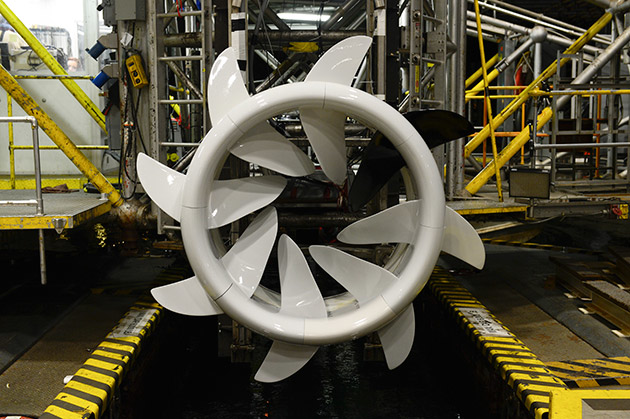
Tidal power has yet to be harnessed on a large scale, but has the potential to replace fossil fuels as a primary energy source in major energy markets. The Climate Institute recognizes that Oceana Energy Company has developed a game-changing device, poised to provide non-intrusive, predictable, and carbon neutral power to some of the world’s largest cities.
The Climate Institute research team has helped support business development materials for Oceana, including drawing attention to the hydrokinetic turbines. Several founding board members of the Climate Institute were instrumental in establishing Oceana. Climate Institute supports the proliferation of this technology in order to provide another option for countries to expand their renewable energy portfolio. Oceana’s devices have the potential to generate cost effective power that speed the transition away from fossil fuels.
Read More about Oceana Here